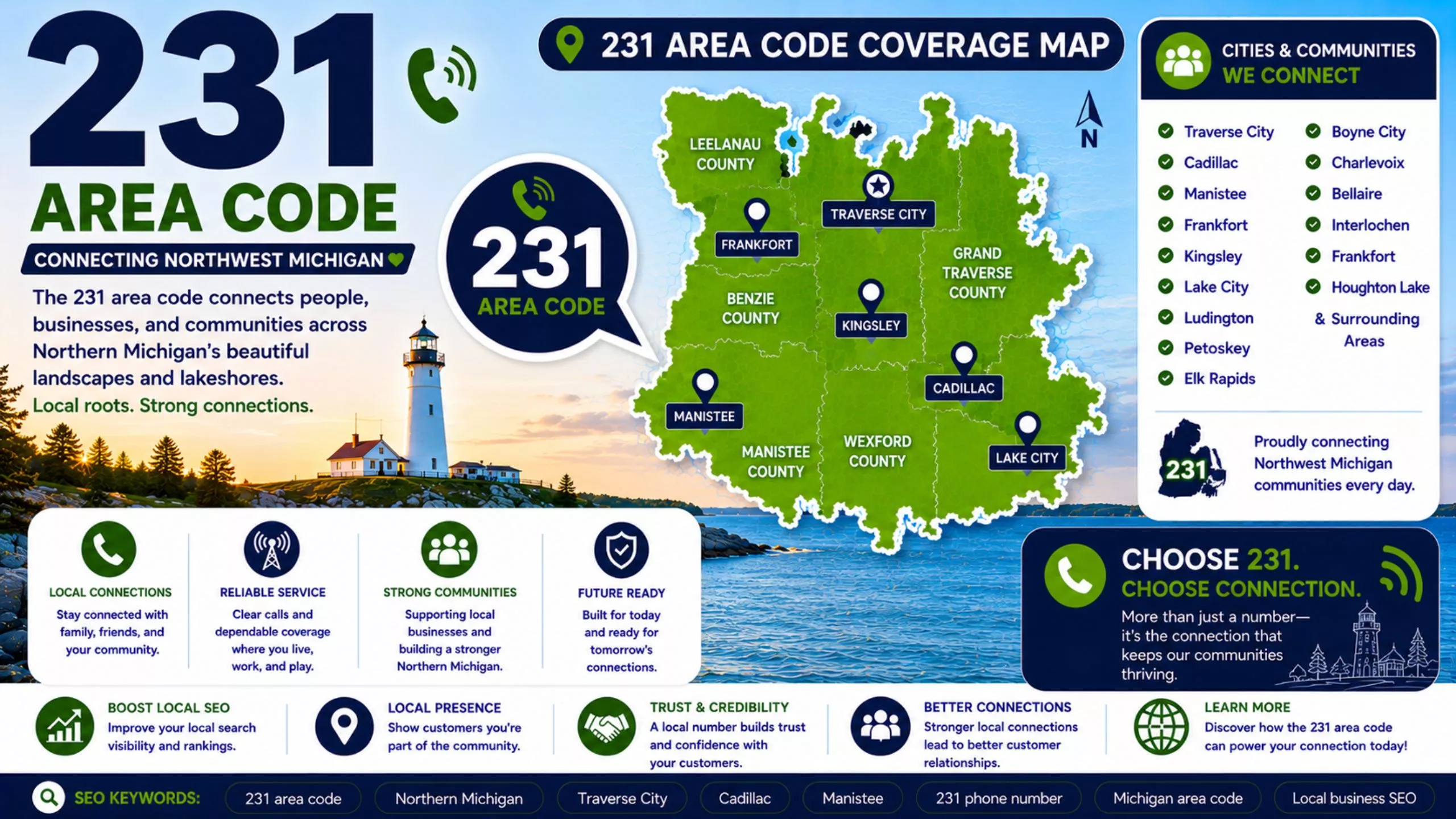
The 231 area code serves the northwestern Lower Peninsula of Michigan, including Traverse City, Muskegon, Cadillac, Petoskey, Ludington, and Manistee. It has been in service since June 5, 1999, sits entirely in the Eastern Time Zone, and is not a toll-free or scam-specific prefix. Like any area code, robocallers can spoof it.
What Is the 231 Area Code?
In 1999, regulators created 231 area code in michigan by splitting it from the original 616 areas codes, which had previously covered the entire western half of Michigan. Today, area code serves the northwestern portion of Michigan’s Lower Peninsula as a geographic telephone area code within the North American Numbering Plan (NANP).
Where Is the 231 Area Code Located?
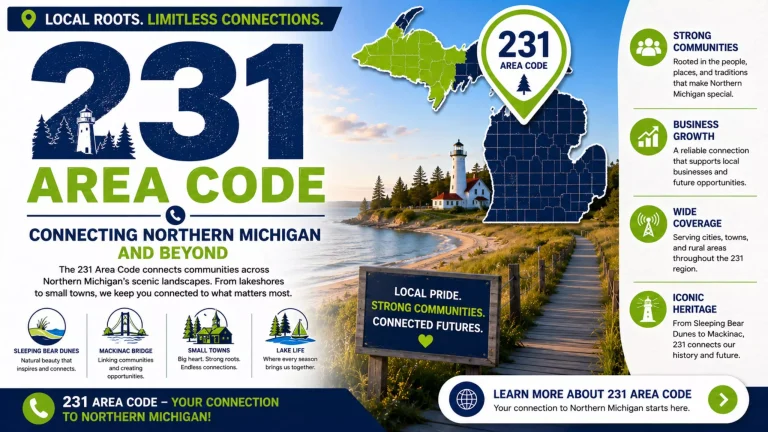
The area code 231 in michigan covers a large stretch of Northern and West Michigan, running roughly from Muskegon in the south up to Petoskey near the tip of the Lower Peninsula. It also reaches one small pocket in the Upper Peninsula (Bois Blanc Township).
Major Cities in the Area Code
| City | County | Known For |
|---|---|---|
| Traverse City | Grand Traverse County | Cherry Festival, wine country, tourism |
| Muskegon | Muskegon County | Lake Michigan port city, manufacturing |
| Cadillac | Wexford County | Manufacturing, outdoor recreation |
| Petoskey | Emmet County | Resort community, “Petoskey stones” |
| Ludington | Mason County | Lake Michigan car ferry, state park |
| Manistee | Manistee County | Historic lumber town, Lake Michigan coast |
| Big Rapids | Mecosta County | Home to Ferris State University |
The area code also touches dozens of smaller communities, such as Charlevoix, Boyne City, Harbor Springs, Kalkaska, Frankfort, Suttons Bay, and more, spanning roughly 20+ counties across Northern Michigan.
History: Why Does the 231 Area Code Exist?
Area code 231 was created in June 1999 by splitting areas codes 616, which had previously served the entire western half of Michigan’s Lower Peninsula. As demand for phone numbers grew through the 1990s, driven by pagers, fax lines, and the early wave of mobile phones, the original 616 numbering pool began to run out of available combinations. Regulators split the region along a north-south line roughly aligned with the Mackinac Bridge, carving out 231 to cover the northern portion. At the same time, 616 continued to serve Grand Rapids and southern West Michigan.
Since that 1999 split, 231 has not required an overlay, meaning the number capacity in the region has remained sufficient for over two decades without further division.
Time Zone
The entire telephone area code 231 operates on Eastern Time (ET), Eastern Standard Time (EST, UTC-5) in winter and Eastern Daylight Time (EDT, UTC-4) during Daylight Saving Time, which runs from the second Sunday in March through the first Sunday in November.
Is a Number a Scam?
No, 231 is a standard, legitimate geographic area code, not a toll-free or premium-rate prefix. It’s assigned to real landlines and mobile numbers across Northern Michigan, just like any other U.S. area code.
That said, any area code can be “spoofed” by scammers using caller ID technology to make a call appear local, even if it doesn’t originate there. If you receive a suspicious call from a 231 number:
Frequently Asked Questions (FAQs)
Conclusion
The area code 231 location is more than just a set of digits; it’s the telecommunications backbone of Northern Michigan, connecting communities from Muskegon’s industrial waterfront up through Traverse City’s wine country to Petoskey’s resort shores. Since its creation in 1999, it has served the region reliably without ever needing an overlay, a testament to how well the original 616 split was planned.