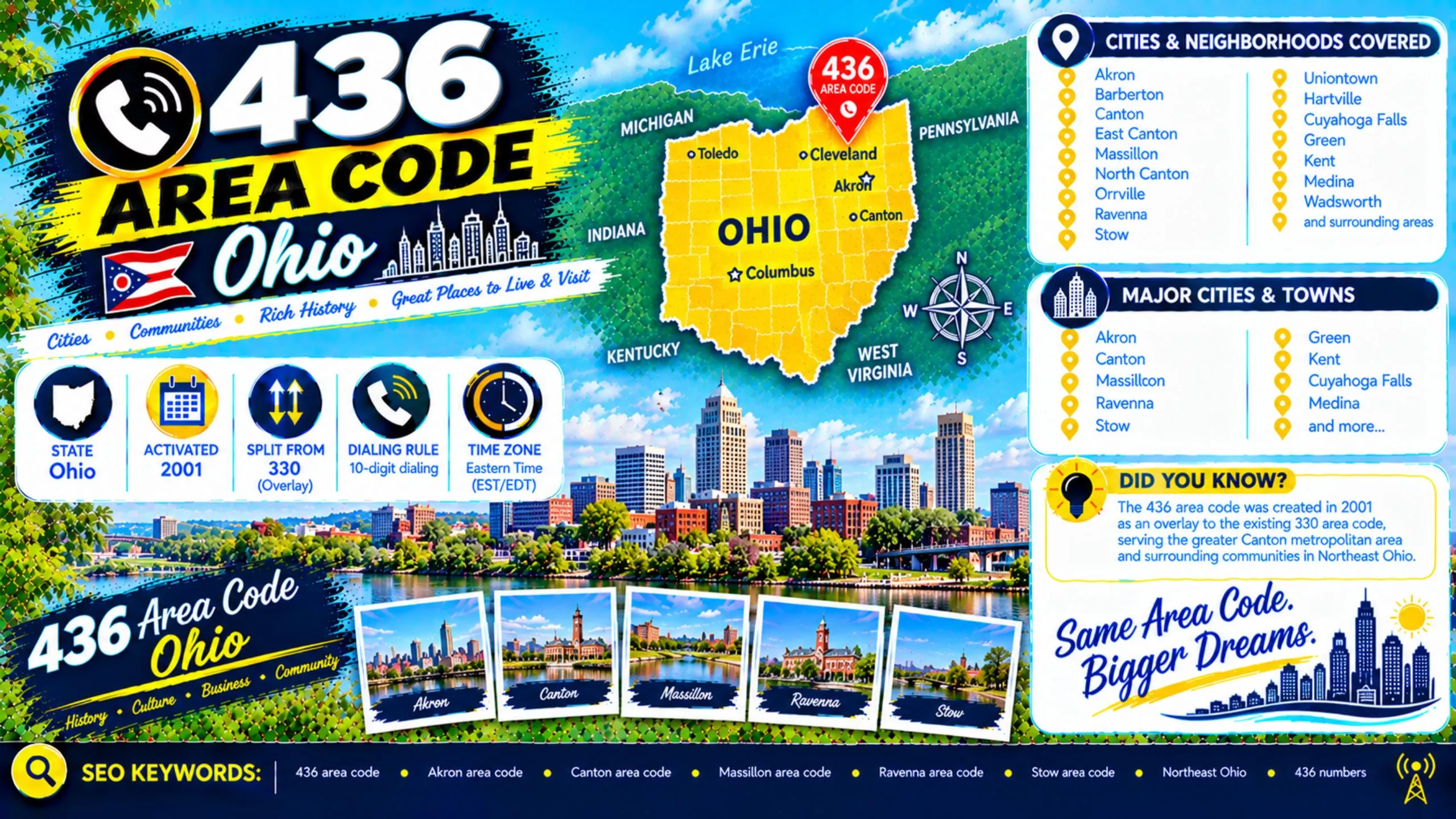
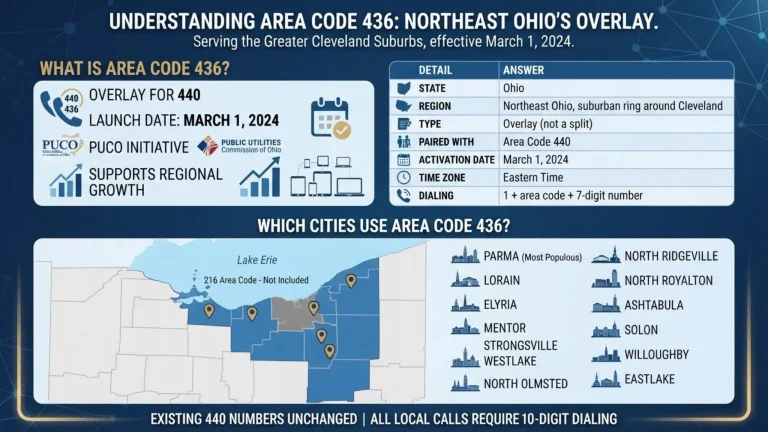
The 436 area code serves the Greater Cleveland suburbs and Northeast Ohio as an overlay for the existing 440 area code. It officially launched on March 1, 2024, to provide more phone numbers as regional demand increased. The 436 area code covers major communities such as Parma, Lorain, Elyria, and Mentor, across counties including Cuyahoga, Lake, Lorain, Geauga, and Ashtabula. Since 436 operates as an overlay, existing 440 phone numbers remain unchanged, but callers must use 10-digit dialing for all local calls within the region.
What Is Area Code 436?
Area code 436 serves the Greater Cleveland suburbs and Northeast Ohio as an overlay for the existing 440 area code. The Public Utilities Commission of Ohio (PUCO) introduced it on March 1, 2024, to provide additional phone numbers as the supply of available numbers in the 440 region declined.
Quick facts
| Detail | Answer |
|---|---|
| State | Ohio |
| Region | Northeast Ohio, the suburban ring around Cleveland |
| Type | Overlay (not a split) |
| Paired with | Area code 440 |
| Activation date | March 1, 2024 |
| Time zone | Eastern Time |
| Dialing | 1 + area code + 7-digit number |
Which Cities Use the 436 Area Code?
The 436 area code serves roughly 50 municipalities across the southern, western, and eastern suburban rings surrounding Cleveland, as well as several lakefront counties in Northeast Ohio.
Major cities covered
Because it is a direct overlay of the 440 area code, it covers the exact same footprint. The largest and most prominent cities utilizing the 436 area code include:
Why Was Area Code 436 Created?
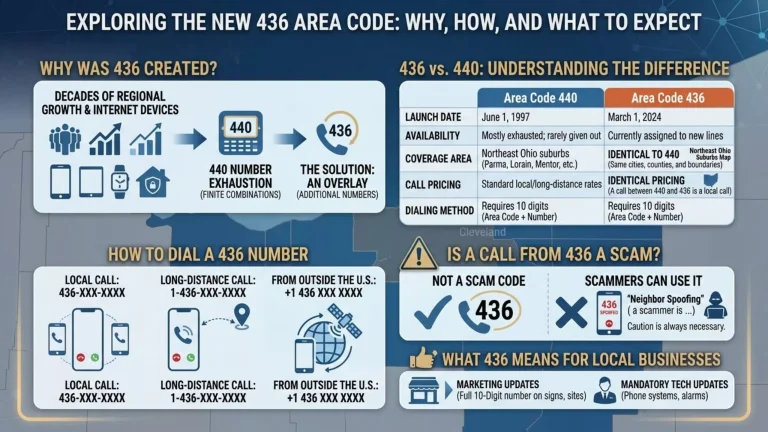
The 436 area code was created because the existing 440 area code was running out of phone numbers. Every area code has a finite number of combinations for 7-digit phone numbers. Due to decades of regional population growth and an explosion in the number of internet-connected devices such as cell phones, tablets, smartwatches, and home security systems, the available pool of unassigned numbers in the 440 region neared complete exhaustion.
436 vs. 440: What’s the Difference?
There is no geographical difference between the two area codes; the only difference is the age of the phone line. Because 436 is an overlay of 440, both codes serve the exact same physical region in the Greater Cleveland suburbs and Northeast Ohio.
| Feature | Area Code 440 | Area Code 436 |
|---|---|---|
| Launch Date | June 1, 1997 | March 1, 2024 |
| Availability | Mostly exhausted; rarely given out | Currently assigned to new lines |
| Coverage Area | Northeast Ohio suburbs (Parma, Lorain, Mentor, etc.) | Identical to 440 (Same cities, counties, and boundaries) |
| Call Pricing | Standard local/long-distance rates | Identical pricing (A call between 440 and 436 is a local call) |
| Dialing Method | Requires 10 digits (Area Code + Number) | Requires 10 digits (Area Code + Number) |
How to Dial a 436 Number
To dial a 436 number, you must use 10-digit dialing (the 3-digit area code followed by the 7-digit phone number) for every call, regardless of whether you are calling from a local or long-distance line.
Is a Call From 436 a Scam?
No, the 436 phone code itself is not a scam code, but a call from a 436 number could still absolutely be a scammer. Because 436 is a legitimate, official U.S. area code serving Northeast Ohio, it is not inherently dangerous like certain international “one-ring” scam codes (such as 284 or 876).
What 436 Means for Local Businesses
For businesses operating in Northeast Ohio, the rollout of the 436 area code means a shift in marketing and mandatory technology updates, rather than any changes to billing or service boundaries.
Frequently Asked Questions(FAQs)
Conclusion
In conclusion, the introduction of the 436 area code marks a seamless expansion of Northeast Ohio’s telecommunications landscape, designed to support the region’s continued digital growth without disrupting existing services.
By acting as a direct overlay to the nearly exhausted 440 area code, it ensures that long-time residents and businesses can keep their established phone numbers, while opening up millions of new lines for incoming users.