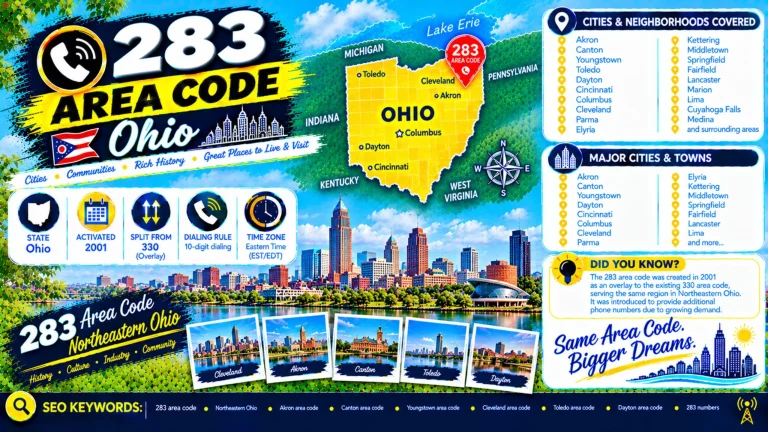
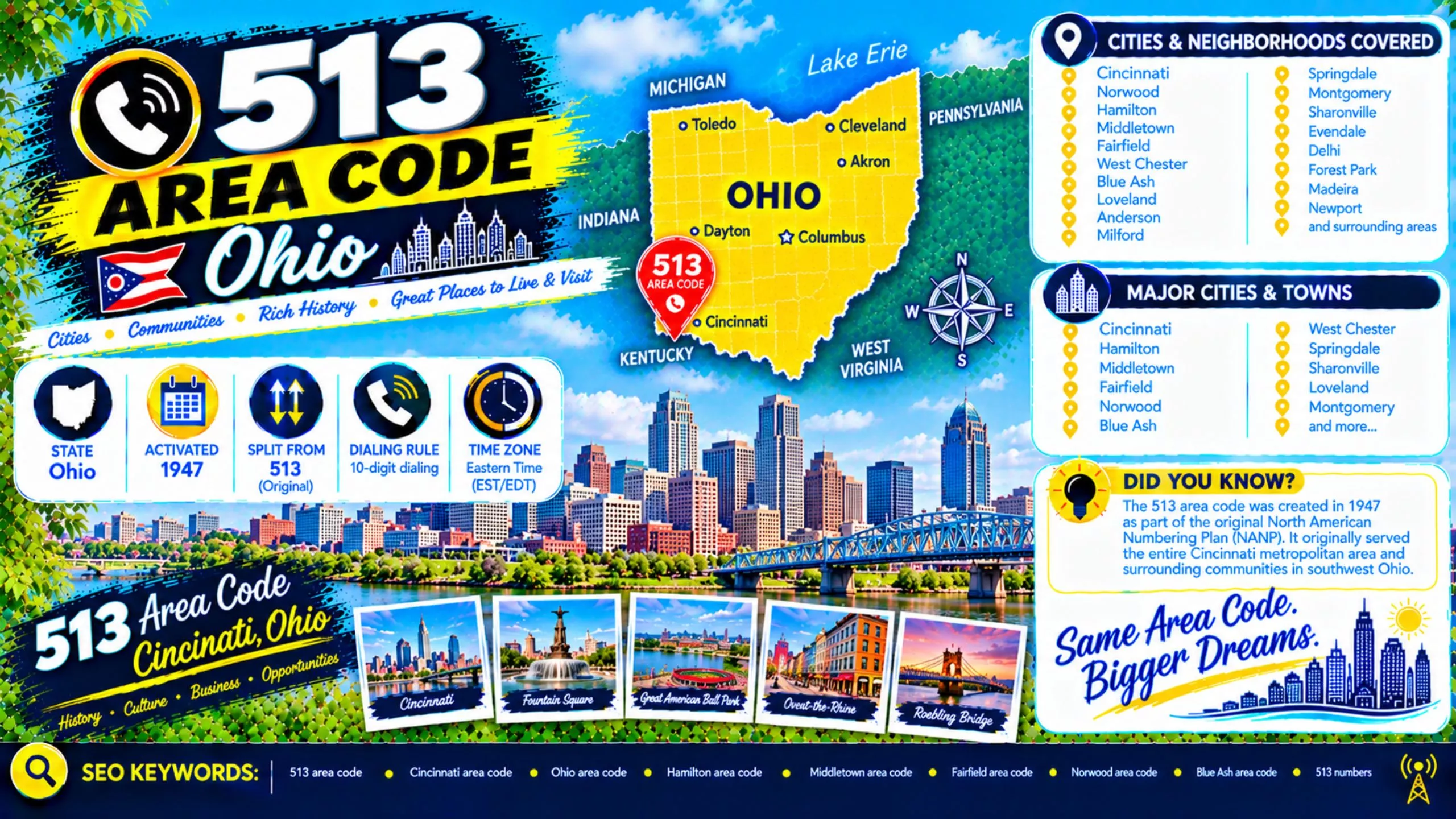
Area code 513 serves southwestern Ohio, mainly around the city of Cincinnati. Introduced in 1947 as one of the original 86 area codes in the United States, it initially covered a larger part of southwestern Ohio. However, officials split the area code in 1996 to meet the growing demand for phone numbers. Today, area code 513 shares its geographic region with the 283 overlay code, so callers must dial all 10 digits for local calls. The region includes major communities such as Hamilton, Middletown, Fairfield, and Mason.
What Is the 513 Area Code?
The 513 area code is the primary telephone area code serving southwestern Ohio, including the city of Cincinnati and its surrounding metropolitan area.
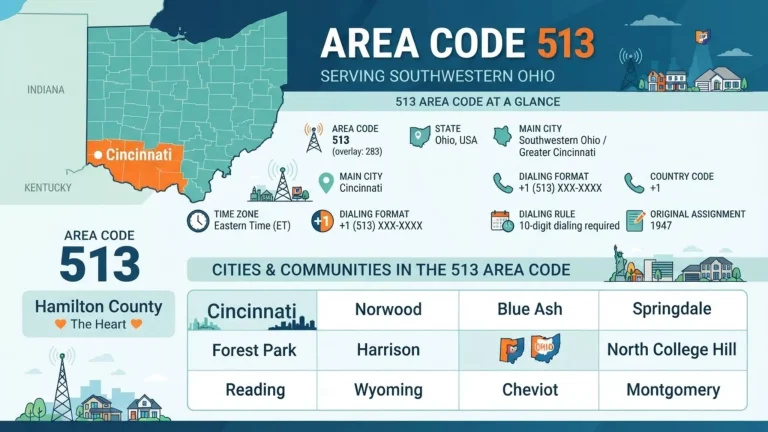
513 Area Code at a Glance
| Detail | Information |
|---|---|
| Area code | 513 (overlay: 283) |
| State | Ohio, USA |
| Main city | Cincinnati |
| Region | Southwestern Ohio / Greater Cincinnati |
| Time zone | Eastern Time (ET) |
| Country code | +1 |
| Dialing format | +1 (513) XXX-XXXX |
| Dialing rule | 10-digit dialing required |
| Original assignment | 1947 |
Where Is Area Code 513 Located?
513 area code location in the southwestern corner of Ohio, primarily encompassing the Cincinnati metropolitan area. It sits right along the borders of Kentucky and Indiana.
Cities and Communities in the 513 Area Code
The area code is 513 covers a diverse mix of urban centers, historic river towns, and growing suburban communities across five counties in southwestern Ohio (Hamilton, Butler, Warren, Clermont, and Preble). As the most populous county in the region, Hamilton County forms the heart of the 513 area code.
History of the 513 Area Code
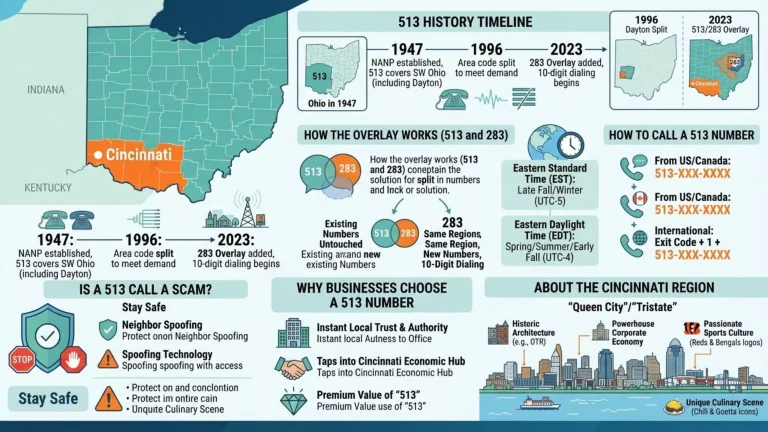
The history of the location of 513 area code spans nearly eight decades, mirroring the rapid growth of telecommunications and the expansion of the greater Cincinnati region. In 1947, AT&T and the Bell System established the North American Numbering Plan (NANP), dividing Ohio into four geographic quadrants. Area code 513 was assigned to the entire southwestern quadrant of Ohio, which included both Cincinnati and Dayton.
513 and 283: How the Overlay Works
An area code overlay is a telecommunications solution where a new area code is added to the exact same geographic region as an existing area code.
Instead of cutting a region in half and forcing half the residents to change their phone numbers (known as a split), an overlay leaves all existing numbers completely untouched. Here is exactly how the 513 and 283 overlay works in southwestern Ohio.
Time zone
The 513 code area and 283 area code region is entirely located in the Eastern Time Zone (ET).
How to Call a 513 Number
To call a area 513 phone number, you must use 10-digit dialing, even if you are calling from another 513 number right next door.
Is a 513 Call a Scam? How to Stay Safe
No, a 513 area is not inherently a scam. It is a legitimate, official telephone area code that has served the Cincinnati and southwestern Ohio region since 1947. However, because it is a highly recognized code, scammers frequently use “caller ID spoofing” technology to make their calls appear as if they are coming from a local 513 number. This trick called neighbor spoofing is designed to lower your guard so you will answer the phone.
Why Businesses Choose a 513 Number
Businesses actively seek out and maintain phone code 513 numbers because a phone number is a critical piece of branding. Even as digital communication evolves, having a local area code offers significant psychological and operational advantages.
About the Cincinnati Region
The Cincinnati region, affectionately known as the “Queen City” or the “Tristate,” is a vibrant metropolitan area anchoring the southwestern corner of Ohio and flowing seamlessly into Northern Kentucky and Southeastern Indiana. Centered around the scenic Ohio River, the region blends historic European-inspired architecture, a powerhouse corporate economy, and a passionate sports and culinary culture.
Frequently Asked Questions(FAQs)
Conclusion
In conclusion, the area code 513 location is far more than just a string of digits; it is a historic and vital part of southwestern Ohio’s identity. From its creation as one of America’s original area codes in 1947 to the introduction of the 283 overlay in 2023, this numbering system has seamlessly adapted to the massive technological and population growth of the Greater Cincinnati region.